New Media is saturating the world. It has
become routine for many of us to check our social media accounts daily. Albrow (1990) as cited
by Rantanen theorizes the “world (being) incorporated into a single world
society, global society” (Rantanen, T 2005). Social Media can be seen as a
testament to this theory. It allows people via the Internet to communicate to
others all around the world, sharing information & personal images. And from its humble beginnings has become integrated into our lives
and daily routine.

Image Citation: http://favim.com/orig/201107/01/boy-coffee-cup-facebook-laptop-man-Favim.com-89578.jpg
A cup of coffee in the morning and a quick
scan of Facebook has replaced the routine of reading the newspaper for many. Social
Media sites such as Facebook, Twitter, and YouTube act as a global flow of
information connecting users & followers around the world.
P. David Marshal argues that social media
use allows for the construction of online personas, in what he describes as the
“specular economy” (p.498 2010).
The specular economy can best be described
by drawing parallels with celebrity representation and the celebrity economy.
Think of celebrities as a commodity, a
commodity that sells products, places, and ideas. Celebrity appearances can
cause immediate advertisement and thusly can be seen as a product; this is part
of the celebrity economy. Because of this economy, Celebrities need to be
careful of how they are presented in public.
Celebrities are the “the product of media
representation” (Duits, L & Van Romondt Vis, P 2007, p.4) and should be
considered to have duel identities. There is the actual person behind the
celebrity and then there is the persona of the celebrity. The persona being “the
distinctive image of a person built up by their mediated appearances” (Evans,
2005: 19), and in-between what we see of a celebrity, there is a make-up
artist, a camera, a photographer and an editor, all there to maintain that
persona. What we know of a celebrity comes “though a collage of mediated texts
like film, concert performances, or video clips… celebrity documentaries and
gossip magazines” (Duits, L & Van Romondt Vis, P 2007, p.4).

An example of this celebrity mediation can
most recently be witnessed with the Miley Cyrus Video Music Awards incident.
Ever since her rise to stardom in the Disney series Hannah Montana the artist
Miley Cyrus has been struggling to change the perception of her Disney
innocence and be seen by the public as an adult. Her Video Music Awards
performance was an outlet to change the public’s perception of her innocence
and was achieved through the over sexualisation of her choreography. According
to Miley Cyrus “It definitely went as planned” (Cyrus, M 2013) showing the
effectiveness of mediated celebrity performances.
From this we can understand that
Celebrities pose and present a metaphorical mask of the self for the public
intake. Mediated celebrity representation parallels public participation in
social media in which “collectively we are becoming more conscious of how we
present ourselves and how others perceive us and this change is migrating to
the epicenter of our knowledge economy” (Marshall, P. David 2010 pp.498-499).
In this instance the specular economy is
referring to how we are becoming progressively aware of our identities and how
people perceive us in public. This extends into the online realm in which the
ability to mediate and fabricate our identity occurs.
So how does the public use social media to
perpetuate the specular economy?
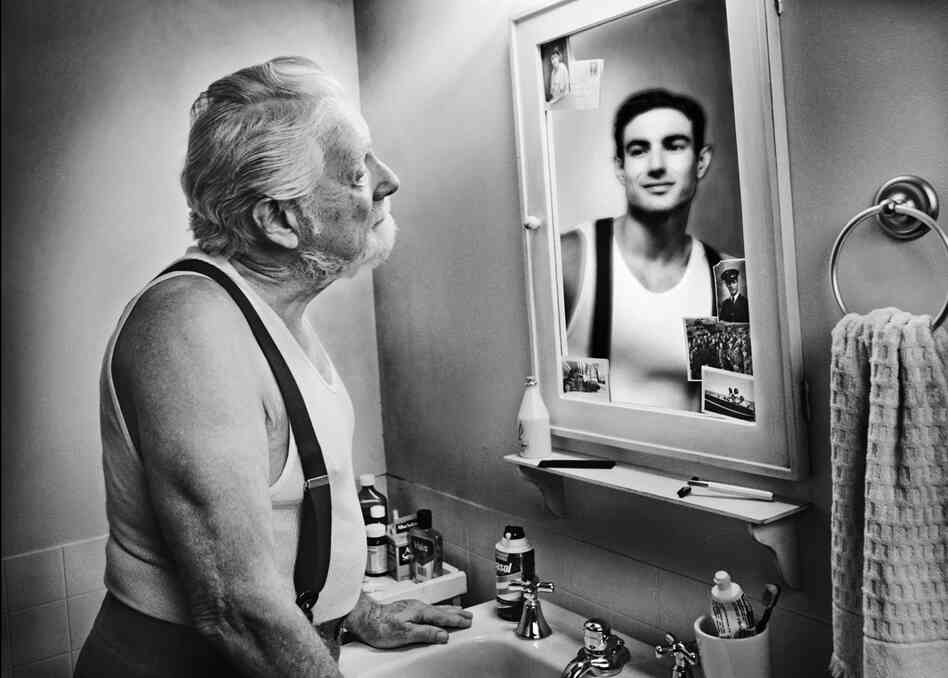
Before we leave the privacy of our houses
for the outside world, it is habitual to check the mirror to make sure we are
properly presented. To ensure that we are well dressed, composed, all in
attempt to avoid scrutiny and to change “our outward behaviors” (Marshall, P.
David 2010 p.499).
I
know when I wake up in the morning my daily routine takes me past the mirror
several times, whether it is brushing my teeth, putting on my clothes,
straitening my hair, and always the final check before leaving the house.
A mirror helps us “to imagine a better
version of ourselves” (Marshall, P. David 2010 p.499) and allows us “strike
poses for future deployment in the outside world” (Marshall, P. David 2010
p.499).
Our online manner is the same, a
performance for public consumption. The metaphor of the mirror is a
representation of the self that is false from its actuality.
“Mirrors parallel what actors do with their
dressing room as they compose their look, their mask, for the next scene and
the next performance” (Marshall, P. David 2010 p.499). An example of this
behavior can be witnessed through uploaded photos on social media sites. The
user can mediate photographs that are presented on social media. The user
chooses which photos to upload, most frequently being one that portrays the
desirable or unique attributes of them selves. Additionally thanks to increased
accessibility to technology the public has access to photo editing software and
phone apps like Instagram that make image editing easy, allowing for increased
mediation of uploaded photographs. This is just one example of how the public
changes their identity for public scrutiny as an “online identity facilitates
persona adoption” (Bullingham, L, & Vasconcelos, A 2013 p.2).
The images we present on social media are
apart of our online identities, which can differ greatly from our offline
identities. We facilitate our own online identities and release only the
positive features/information we want the public to receive. Our online
identity is the image that we release to the public via our own mediated online
responses. Bullingham and Vasoncelos argue that “the distance between performer
and audience that physical detachment provides makes it easy to conceal aspects
of the offline self and embellish the online”. In this instance, social media
sites allow for the separation of the self and persona we want people to see.

Because of the anonymity available on the
Internet “online deception is prevalent” (Huang, C, & Yang, S 2013 p.2).
Frequently this occurs on online dating sites in which the users construct
false identities in hopes of forming relationships.
Imagine for a moment that you have been
active in an online dating site and you are finally meeting the man/woman
you’ve been interacting with at a local café.
You arrive at the café only to find the
person has lied to you about their age and appearance. According to Huang &
Yang in their online dating studies “subjects reported younger ages, falsified
pictures (including retouching pictures to present themselves as more
attractive, thinner, or prettier), and falsified hairstyles and skin qualities”
(2013 p.2). This online misrepresentation is relevant to the specular economy
as participating in social media is a “kind of public performance of the self
that we all engage in as we exit into the public (online) world” (Marshall, P.
David 2010 p.500). It gives users the ability to fabricate certain details of
their identity and portray embellishments of the personality and the physical
appearance.
Advances in technology and “new media have
produced this expanded specular economy and its production of an industry of
persona construction” (Marshall, P. David 2010 p.500).
Personally I am guilty of online
misrepresentation at times. The photographs I post are often staged, my status
updates are grammatically correct to convey a sense of finesse (completely
opposite to my offline and private self) and I always let people know of my
good grades from tertiary studies, all in attempt to portray myself differently
to my actuality. Do you misrepresent yourself online, or is your online
identity identical to your offline identity? Do you have a façade?
David Macardy
Citations:
Bullingham, L, & Vasconcelos, A 2013,
“The presentation of the self in the online world”: Goffman and the study of
online identities, Journal of Information Science, 39, 1, pp. 1-12, Business
Source Complete.
Duits,
L, & Van Romondt Vis, P 2007, 'Girls Make Sense: Girls, Celebrities, and
Identities', Conference Papers -- International Communication Association, pp.
1-23, Communication & Mass Media Complete, EBSCOhost, viewed 14 September
2013.
Evans,
J. (2005) ‘Celebrity, media and history’ in J. Evans and D. Hesmondhalgh (eds)
Understanding media: Inside celebrity, pp. 12-55. Maidenhead: Open University
Press.
Huang, C, & Yang, S 2013, “Study of
Online Misrepresentation, Self-Disclosure, Cyber-relationship Motives, and
Loneliness Among Teenagers In Taiwan”, Journal of Educational Computing
Research, 48, 1, pp. 1-18, Education Research Complete.
Marshall, P. David 2010, ‘The Specular
Economy’, Symposium: Celebrity Around the World, Springer Science + Business
Media, LLC 2010 pp. 498-502.
Miley Cyrus: The VMA Performance Went
According to Plan/ Variety. 2013. Miley Cyrus: The VMA Performance Went
According to Plan/Variety. Available at:
http://variety.com/2013/tv/news/miley-cyrus-the-vma-performance-went-according-to-plan-1200702296/